LifeOS
An experiment in turning notes and source material into searchable knowledge and citation-linked conversations.
Live Demo & Source
Demo Expert: Dalai Lama
The public demo includes a synthesized expert persona built from books, talks, and transcripts, allowing visitors to explore how LifeOS transforms source material into conversational expertise.
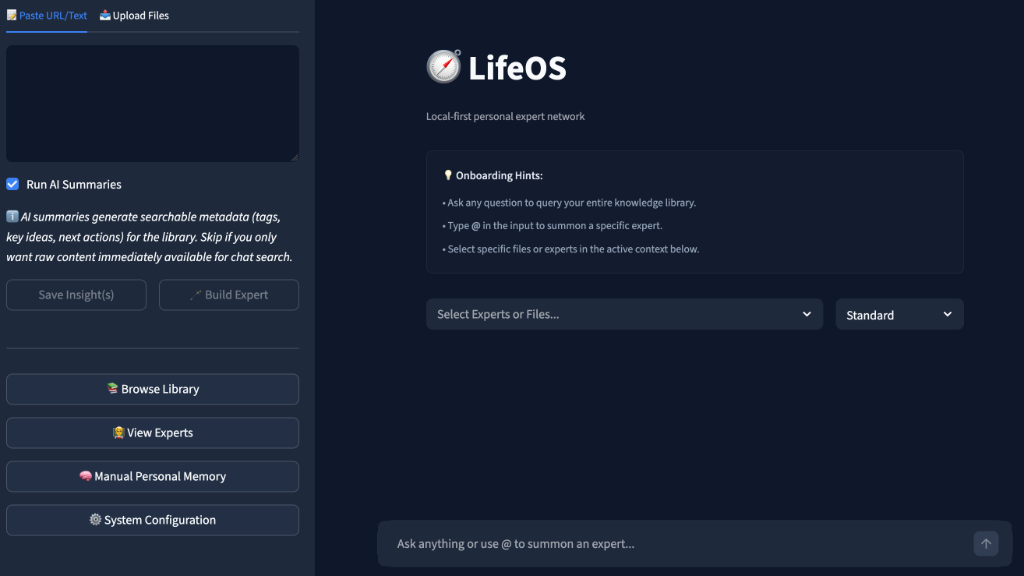
LifeOS transforms notes, transcripts, books, videos, and resources into searchable expert personas and conversational knowledge systems.
Project Outcomes
- ✓ Public interactive demo
- ✓ Expert personas synthesized from source material
- ✓ Citation-grounded conversational retrieval
- ✓ Automated YouTube and web knowledge ingestion
- ✓ MCP-compatible knowledge server
Overview
LifeOS is an experiment in turning personal knowledge into an active thinking environment.
Rather than storing notes, transcripts, books, and resources in isolated systems, the platform transforms them into searchable expert personas, structured knowledge libraries, and conversational AI assistants grounded in source material.
The goal is not simply retrieval.
The goal is helping knowledge become more useful.
Why I Built It
Over the years I accumulated notes, transcripts, books, courses, project artifacts, and research across multiple systems.
Finding information was rarely the problem.
Making use of it was.
LifeOS began as an exploration of whether AI could help transform a collection of information into a network of experts, principles, and actionable insights.
The project combines personal knowledge management, retrieval systems, expert synthesis, and AI-assisted workflows into a single environment.
Core Question
Can personal knowledge become an active thinking partner rather than a passive storage system?
Key Components
Expert Personas
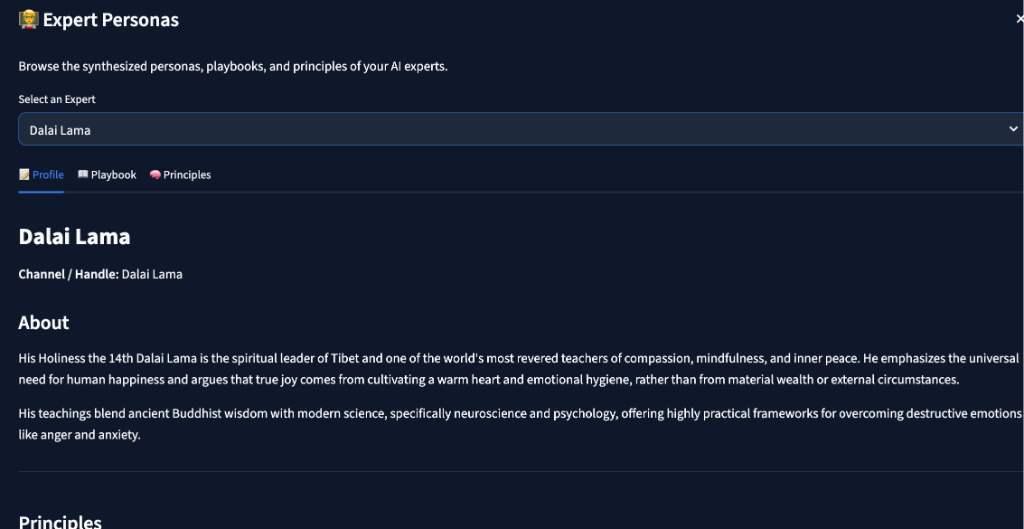
LifeOS automatically synthesizes expert profiles, playbooks, and principles from ingested knowledge.
Rather than manually searching documents, users can interact with curated expert perspectives grounded in source material.
Conversational Retrieval
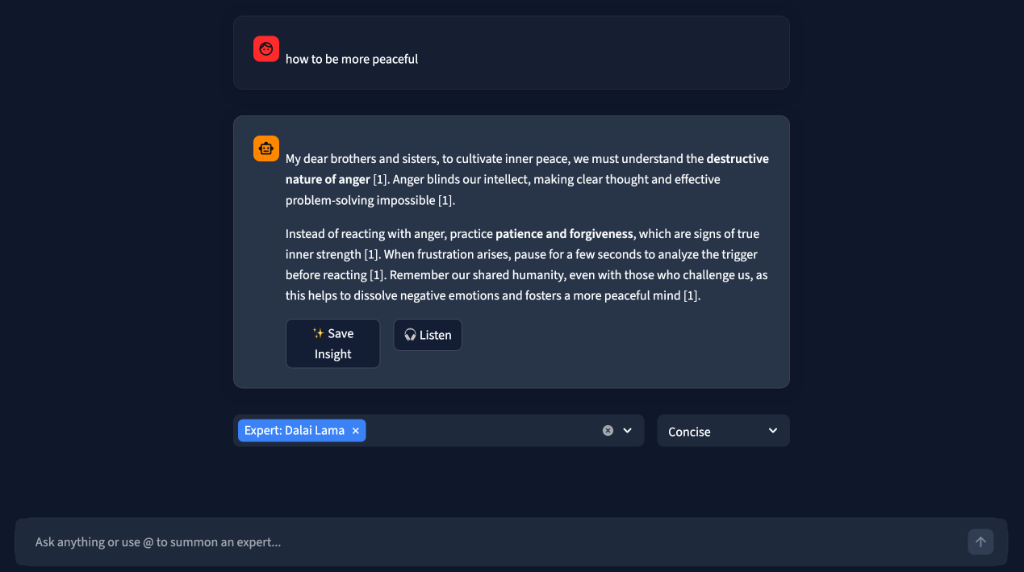
Multi-turn chat with citations and expert routing.
Questions can be answered by a specific expert persona or across the entire knowledge base.
Knowledge Library
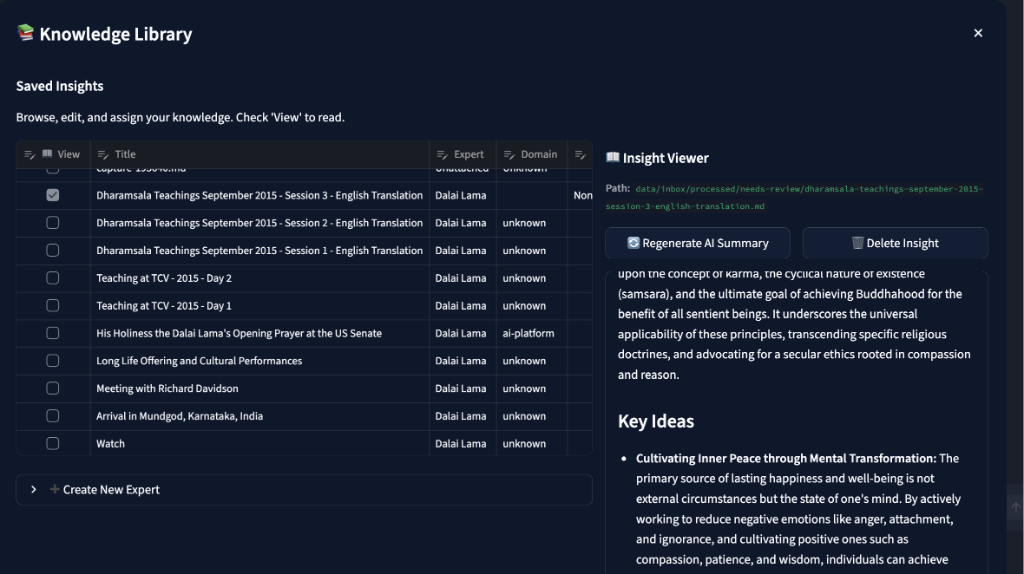
Structured storage for notes, transcripts, summaries, and source material.
Every resource remains searchable, organized, and linked to its original source.
Hermes Automation Experiment
I also experimented with Hermes: a workflow that reviewed newly added knowledge and proposed code improvements through pull requests. That earlier experiment does not describe how I currently publish notes to this website.
I now select and add website notes manually after reviewing the material myself.
System Architecture
LifeOS brought together knowledge ingestion, expert synthesis, retrieval, and experiments with automated workflows in a local-first architecture.
Technology Stack
Core Platform
- Python
- Streamlit
- FastAPI
Knowledge Layer
- Markdown
- YAML Frontmatter
- SQLite FTS5
AI Layer
- Google Gemini
- Azure OpenAI
- OpenRouter
Agent Systems
- MCP (Model Context Protocol)
- Hermes Agent
- GitHub Pull Request Automation
Ingestion
- yt-dlp
- BeautifulSoup
- Jina Reader
Testing & Quality
- pytest
- GitHub Actions
Current Status
Active development. Currently deployed as a public demo and open-source project.
Current capabilities include:
- Expert synthesis
- Conversational retrieval
- YouTube ingestion
- Web ingestion
- MCP integration
An earlier Hermes experiment explored automated review and pull requests.
Future work includes offline models, richer knowledge visualizations, and expanded agent capabilities.
Lessons Learned
The hardest challenge was not retrieval.
It was creating structures that make knowledge useful.
Large language models are increasingly capable of synthesizing information, but the quality of their outputs depends heavily on how knowledge is organized.
LifeOS reinforced the idea that knowledge management is less about collecting information and more about creating clarity, context, and action.