Moxa Point Finder
State-aware AI assistant combining retrieval, workflow logic, and conversational guidance to make complex knowledge easier to access.
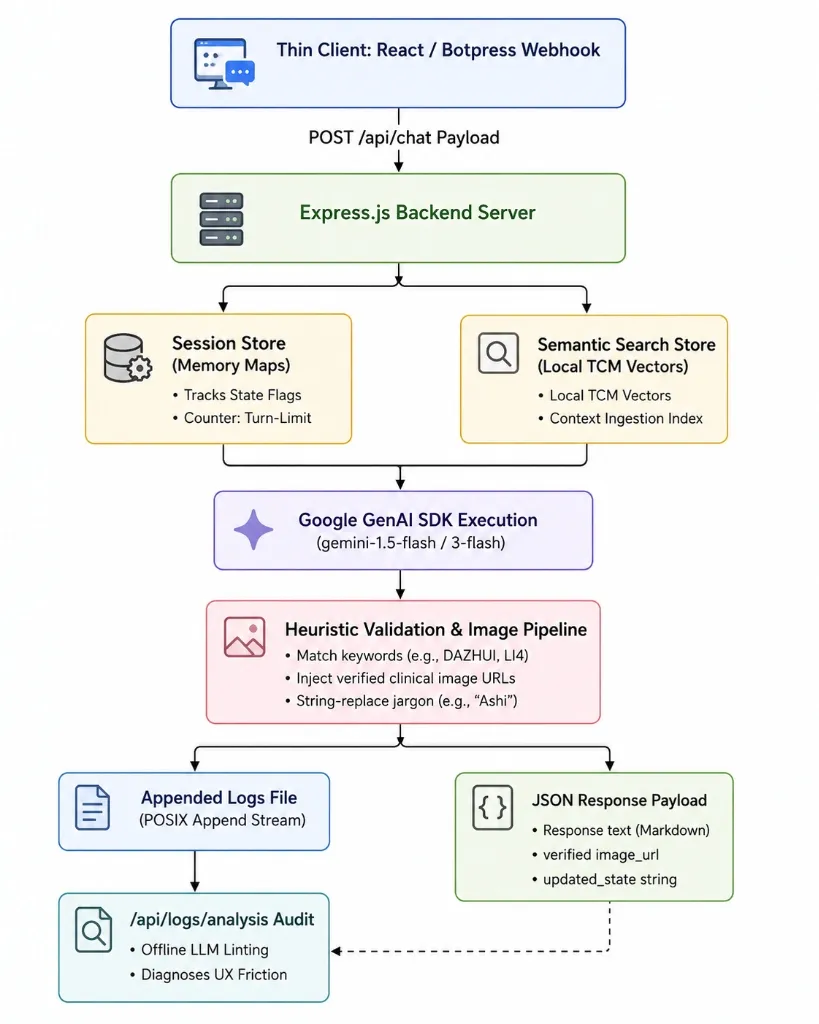
System Architecture
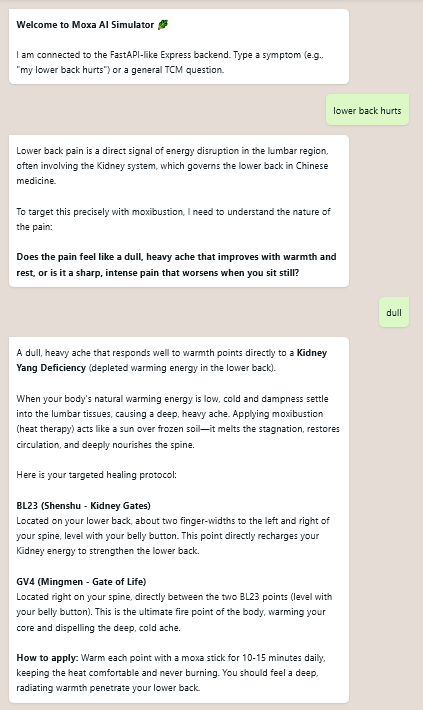
Example Conversation Flow
Moxa Point Finder helping users navigate moxibustion points and traditional wellness concepts through conversational guidance.
Project Outcomes
- ✓ Working AI assistant
- ✓ Telegram integration
- ✓ Structured TCM knowledge retrieval
- ✓ Visual point guidance
WhatsApp and broader Flow Temple integration are planned work, not completed outcomes.
Overview
Moxa Point Finder began as a practical question.
While researching moxibustion, I noticed that beginners often struggle with the same challenges:
- unfamiliar terminology
- difficulty locating points
- uncertainty about where to begin
- overwhelming amounts of information
Many existing resources assume prior knowledge.
The goal of Moxa Point Finder is to make these concepts more approachable through guided conversation, visual support, and structured knowledge retrieval.
What started as a learning aid gradually evolved into an exploration of AI-assisted education and conversational system design.
Why I Built It
One of the recurring challenges in Traditional Chinese Medicine is accessibility.
Experienced practitioners can navigate concepts such as meridians, points, constitutions, and symptom patterns naturally.
Beginners often cannot.
I wanted to explore whether an AI assistant could reduce that barrier while still remaining grounded in reliable source material.
The project also became an opportunity to experiment with retrieval systems, conversational UX, and constrained AI interactions.
Core Question
How can conversational AI make complex knowledge easier to access without sacrificing accuracy or overwhelming the user?
Architecture
The assistant combines conversational AI with retrieval, workflow logic, safety validation, and visual learning support.
Rather than relying on the language model alone, the design uses additional layers to structure responses and handle safety concerns. These safeguards do not make it a diagnostic tool.
Key Components
Knowledge
- • Structured TCM references
- • Semantic search
- • Context injection
State
- • Tracks conversation progress
- • Limits repeated questions
- • Guides outcomes
Visuals
- • Point diagrams
- • Curated image assets
- • Beginner-friendly explanations
Safety
- • Validation rules
- • Turn limits
- • Response checks
Product Evolution
Iteration 1 — Body Mapping Interface
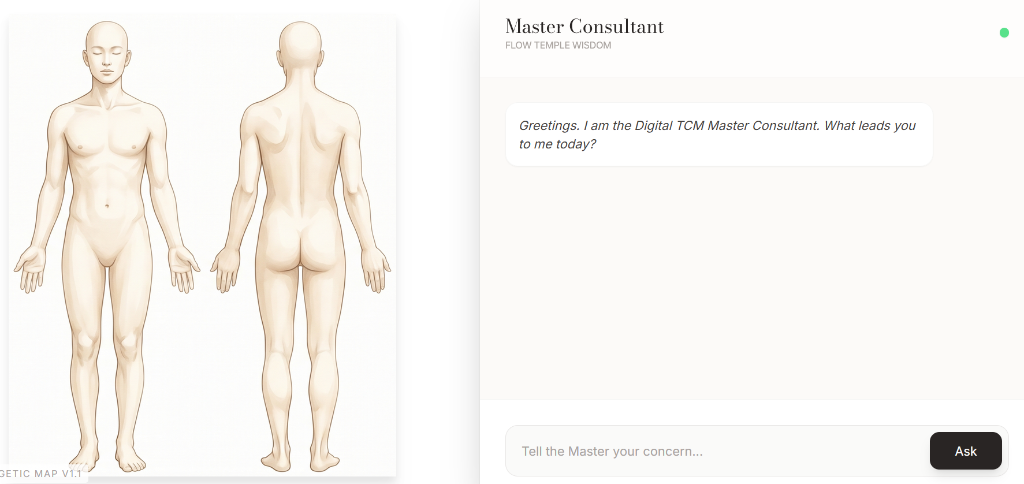
3D Body Interface
Initially I experimented with a visual body interface where users selected pain locations directly.
The concept required users to visit a dedicated website and navigate a body interface before asking a question. I decided to test a simpler conversational entry point.
Iteration 2 — Web Assistant
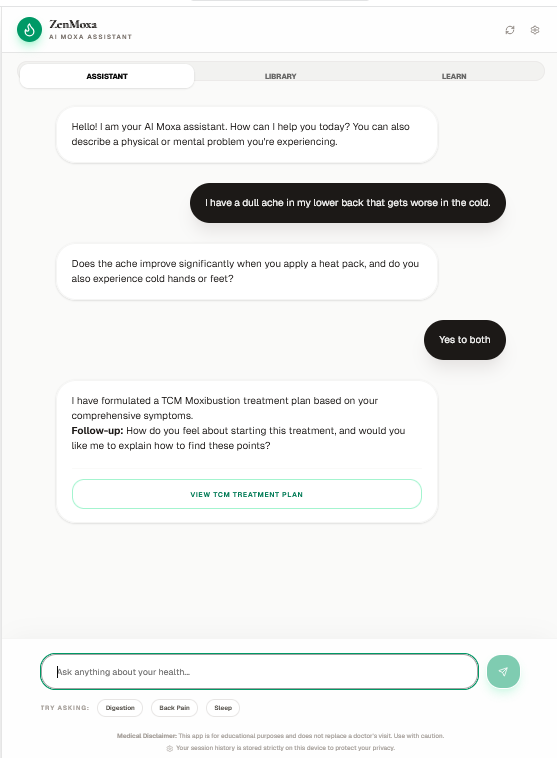
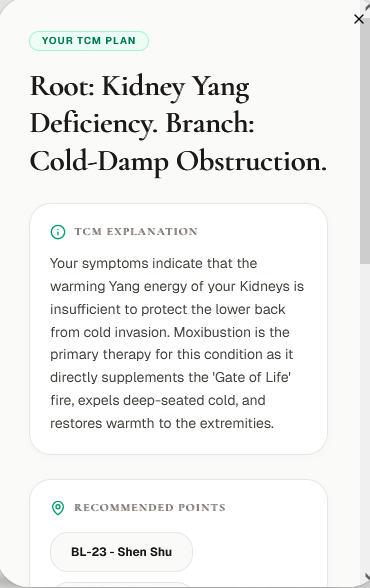
ZenMoxa Web Assistant
The next prototype explored conversational explanations and suggested learning paths. Any treatment-like output required careful review and was not a validated treatment plan.
It still required users to visit a separate platform, which led me to test a messaging-based version.
Final Direction — Messaging First
The project ultimately shifted toward Telegram and WhatsApp.
Messaging platforms offered a way to test the assistant in tools people already use. I chose Telegram for the working integration, while WhatsApp remained in progress; I have not measured whether the shift improved accessibility.
Technology Stack
AI Layer
- Google AI Studio
- Gemini API
- Prompt Engineering
- State-Aware Workflows
Backend
- Node.js
- TypeScript
- Express
- Railway
Conversation Layer
- Botpress
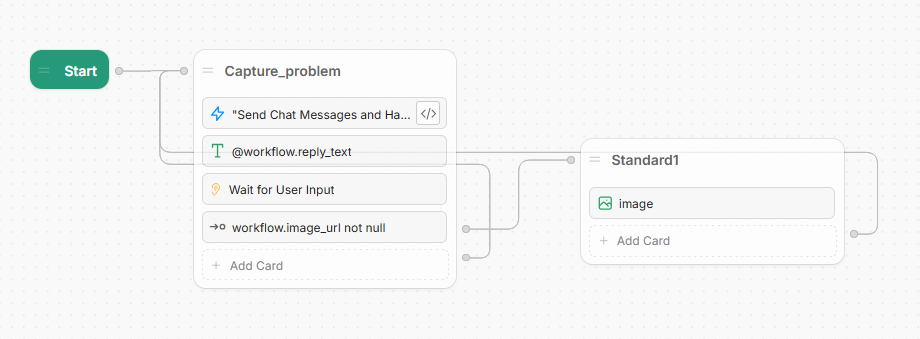
Botpress Routing Logic
Channels
- Telegram
- WhatsApp (In Progress)
Knowledge Layer
- RAG
- Semantic Search
- Structured Knowledge Base
Frontend Prototypes
- React
- Tailwind CSS
Current Status
The assistant is currently deployed through Telegram, with WhatsApp integration in progress.
The current work is focused on conversational quality, knowledge coverage, and retrieval. WhatsApp and integration into the broader Flow Temple application remain future steps.
Lessons Learned
The biggest surprise was how much of the challenge existed outside the language model itself.
Generating responses was relatively straightforward.
Designing workflows, handling edge cases, validating outputs, managing conversation state, and creating a smooth user experience turned out to be the more interesting engineering problem.
The project reinforced the idea that useful AI products are rarely just prompts—they are systems.